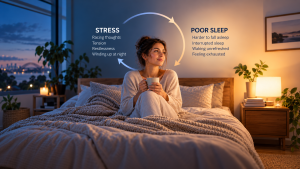

Insomnia often persists because the body learns to stay alert at night, and worrying about sleep keeps that alertness switched on long after whatever first disturbed your rest has passed. What helps most is rarely another sleep tip. It is retraining the sleep system, usually through sleep restriction and stimulus control, while addressing the stress, pain or habits feeding it. If you have spent months watching the ceiling at 3am, this is a genuine health concern, not a failure of willpower.
What counts as insomnia
Insomnia is difficulty falling asleep, staying asleep, or waking too early on at least three nights a week for three months or more, where the poor sleep also affects how you feel and function during the day. A handful of disrupted nights around stress, travel or illness is normal and usually settles by itself. Persistent insomnia is different because the sleep problem has taken on a life of its own and no longer tracks the original trigger.
That distinction matters more than it sounds. People often ask whether they “really” have insomnia or are simply bad sleepers, and the honest answer is that if broken sleep has been a fixture for months and your days are suffering, the label matters far less than getting the right help. Naming it accurately is still useful, because chronic insomnia responds to different approaches than the odd rough night.
Why insomnia persists
The frustrating part of long-term insomnia is that it often outlasts its cause. A stressful period, a new baby, shift work or a bout of pain sets off the broken sleep, but the sleeplessness then becomes self-sustaining. Two things tend to keep it going. The first is heightened arousal, a nervous system that stays wound up at bedtime rather than winding down. The second is conditioning, where the bed and the bedtime routine start to signal frustration and effort instead of rest.
This is why so many people ask why their insomnia keeps coming back even after the original stress has lifted. The more you try to force sleep, the more the trying itself becomes activating, and lying awake for hours teaches the brain that bed is a place of wakefulness. Clock watching, mentally rehearsing tomorrow and doing the mental arithmetic on how little sleep is left all pour fuel on the same fire. Understanding this loop is the first step, because it explains why the fixes that work are the ones that break the association rather than chase more hours.
What actually helps: retraining sleep
The approaches with the strongest evidence for chronic insomnia are behavioural, and together they make up cognitive behavioural therapy for insomnia, widely recommended as the first thing to try before anything else. The Sleep Health Foundation publishes plain-language guidance on these techniques. Two of them do most of the heavy lifting.
Sleep restriction and a consistent rise time
Sleep restriction sounds counterintuitive, because it means spending less time in bed for a while, not more. By matching your time in bed more closely to the sleep you are actually getting, the approach builds a stronger drive for sleep and reduces the long stretches of frustrated wakefulness. A fixed wake-up time, seven days a week, anchors the body clock and is often the single most useful change a person can make. It is demanding in the first week or two, which is exactly why doing it with support rather than alone tends to work better.
Stimulus control: the bed is for sleep
Stimulus control rebuilds the link between bed and sleep. In practice that means going to bed only when sleepy, getting up and leaving the bedroom if you are still awake after what feels like fifteen or twenty minutes, and returning only when sleep feels close. It also means keeping the bed for sleep and intimacy rather than scrolling, working or watching the hours tick by. Over a few weeks the brain relearns that bed means rest, which is the association insomnia erodes.
What a longer assessment looks at
Persistent insomnia rarely has a single cause, which is exactly why it can be so hard to shift alone. It often sits alongside other things that quietly undermine sleep: ongoing pain or discomfort, hormonal changes, digestive symptoms, restless sensations in the legs, the timing of existing medications, low mood, and your caffeine and alcohol patterns. Sometimes another sleep disorder is involved, or several of these are happening at once. A careful assessment matters because it can tell insomnia apart from other causes, or pick up when more than one is in play. Healthdirect notes that insomnia can have a range of causes, from lifestyle factors to medical conditions, which is why an ongoing sleep problem is worth looking at properly rather than assuming it is simply stress.
This is where an unhurried consultation earns its place. A rushed ten minute visit rarely has time to work through a layered sleep problem, whereas a longer appointment can take a proper history and look at the whole picture. Scripted Clinic offers exactly this: longer, unhurried telehealth consultations by phone with an AHPRA-registered doctor, available anywhere in Australia. Booking a natural therapies consultation is one way to do that, always alongside your regular GP rather than instead of one, and it makes thorough assessment far more accessible for people in regional and rural areas who cannot easily reach a clinic.
Caffeine and alcohol deserve a specific mention, since both are commonly misjudged. Caffeine lingers far longer than most people expect, so an afternoon coffee can still be active at bedtime, and alcohol may help you drop off but fragments the second half of the night. The Royal Australian College of General Practitioners supports a stepped approach that starts with these behavioural and lifestyle factors before considering anything else. Looking at sleep in the context of your wider health, rather than in isolation, is the idea behind a holistic approach to long-term symptoms.
Your daytime habits shape your night
What you do during the day has a surprising influence on how you sleep at night. Getting bright light early in the morning, ideally outdoors, helps anchor your body clock and makes it easier to feel sleepy at a sensible hour. Regular physical activity supports deeper sleep for many people, though intense exercise very late in the evening can be activating for some, so it is worth noticing your own pattern rather than following a blanket rule.
Naps are a common trap. A long or late afternoon nap eases the pressure for sleep that builds up across the day, which can make night-time insomnia worse even though the nap feels helpful in the moment. If you do nap, keeping it short and early in the afternoon tends to protect your night. It also helps to know that feeling exhausted all day yet wide awake at bedtime is common, because tiredness and genuine sleepiness are not quite the same thing, and a late nap can quietly drain the sleep pressure that would otherwise help you drop off. In the evening, dimming the lights and stepping back from bright screens in the last hour before bed reduces the alerting signals that keep the brain switched on. None of these are dramatic changes on their own, but together they tilt the odds back in your favour.
A note on sleeping tablets and melatonin
Many people arrive hoping for something to take, so it is worth being clear. In Australia, melatonin and sleeping tablets are prescription-only medicines, and this article does not recommend them or explain how to obtain them. What a doctor can do is talk through whether any prescription option has a place in your situation, weigh it against the behavioural approaches above, and make that decision with you. The evidence consistently points to retraining sleep as the foundation, with any medicine as a limited, carefully considered addition rather than a first move.
When to see a doctor
Some sleep problems are a sign of something that needs assessing rather than self-managing, and it is important to recognise them. See a doctor promptly if you snore loudly and feel very sleepy during the day, or if a partner has noticed you stop breathing or gasp in your sleep, as these can point to a treatable sleep disorder. It is also worth making an appointment if your insomnia has not shifted despite steady changes to your routine, if you suspect another health issue is contributing, if it began suddenly with no clear cause, or if it comes alongside persistent low mood. Ongoing daytime sleepiness that makes it hard to concentrate, drive or operate equipment safely is another clear reason to seek help.
Seek prompt medical attention if poor sleep comes with more serious signs, such as significant breathing difficulty during sleep, episodes of losing consciousness, severe or rapidly worsening physical symptoms, or a marked decline in your mental wellbeing. Healthdirect can help you decide how urgently to seek care. This is exactly the point at which a longer consultation is worthwhile, because a proper history and examination can uncover what a rushed visit misses.
Key things to know about insomnia
- Chronic insomnia is common and treatable, and it responds best to approaches that retrain the sleep system rather than to a single quick fix. If broken sleep has lasted months, it is worth taking seriously.
- The behavioural approaches, sleep restriction and stimulus control, have the strongest evidence, and a fixed wake-up time every day is one of the most powerful changes available. They are demanding at first, so support helps.
- Insomnia rarely lives on its own. Stress, pain, mood, hormones, medication timing, caffeine and alcohol can all feed into it, and sometimes another sleep disorder or health issue is involved. A whole-picture assessment can tell these apart and often finds more to work with than a sleep tip list.
- Natural therapies work alongside your regular GP, not instead of medical care. Warning signs such as loud snoring with daytime sleepiness, low mood or a sudden unexplained onset should always be assessed by a doctor.
Frequently asked questions
Why do I still have insomnia when I am no longer stressed?
The thing that first disrupted your sleep and the things keeping it going are often different. Once poor sleep sets in, changes in your habits, your body-clock timing, and worry about sleep can keep the pattern running long after the original stress has passed.
Is insomnia always caused by stress?
No. Stress is a common trigger, but insomnia can also sit alongside physical health conditions, other sleep disorders, hormonal changes, medication timing, and everyday habits around caffeine, alcohol and screens. This is why a whole-picture assessment is often more useful than a single sleep tip.
How long should insomnia last before I see a doctor?
There is no fixed deadline to wait for. If broken sleep is affecting your mood, concentration or daytime functioning, or it keeps returning despite changes to your routine, it is worth discussing with a doctor rather than pushing through.
How long does it take to improve chronic insomnia?
Many people notice a difference within a few weeks of consistently applying sleep restriction and stimulus control, though the first week or two can feel harder before it feels easier. Because insomnia is usually held in place by several factors, steady change tends to outlast quick fixes.
Can a telehealth doctor help with insomnia if I live rurally?
Yes. Scripted Clinic operates by phone across every state and territory, so a longer sleep assessment does not depend on reaching a physical clinic. This makes thorough, unhurried care more accessible for regional and rural patients.
Reviewed by Scripted Clinic. Last updated 1 October 2026.
Related Posts
No Posts Found in Category 23