
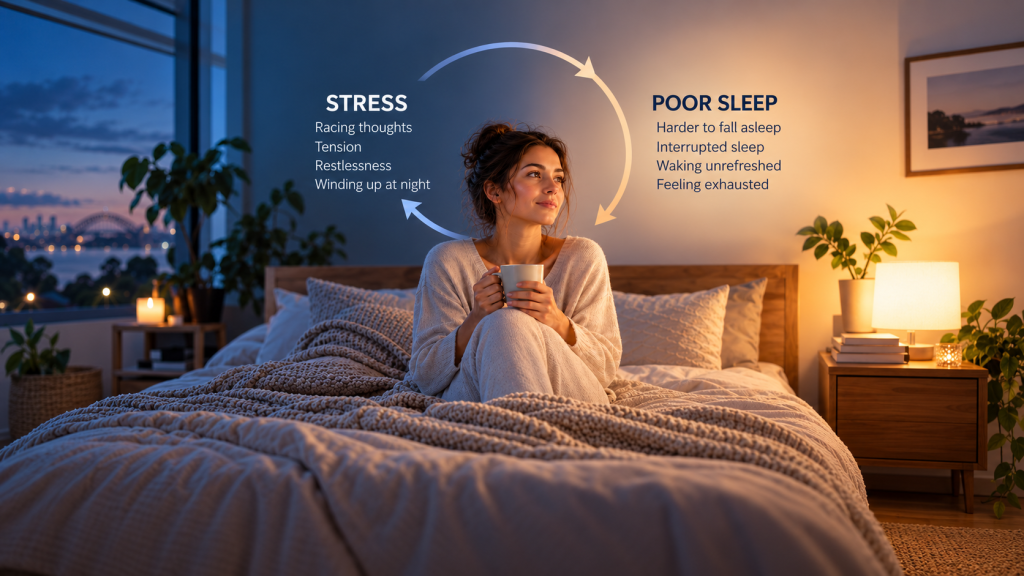
Good stress management matters for sleep because stress and poor sleep feed each other in a loop. Stress keeps the body switched on when it should be winding down, and a short night lowers your threshold for stress the next day. Most people only try to fix one end of that loop, which is why progress stalls. Breaking the cycle means working on both at once, with practical steps you will actually keep up. For readers exploring a broader Natural Therapies approach, the same principle applies: look at the whole pattern rather than chase a single quick fix.
What the stress and sleep cycle actually means
The stress and sleep cycle is the two-way pattern where stress makes it harder to fall asleep, stay asleep or wake feeling restored, and poor sleep then makes the brain and body more reactive the next day. That extra reactivity lowers your tolerance for ordinary pressure, so the next evening you arrive at bedtime more wound up than you would otherwise be.
That is why people often say they feel wired and exhausted at the same time. The body may be tired, but the nervous system is still behaving as though it needs to stay alert. Once that pattern repeats for a while, it can become hard to tell which came first, the stress or the sleep problem, because each one keeps the other going.
Why the cycle keeps going
The frustrating part is that the thing that started the problem is not always the thing that keeps it running. A busy patch at work, family pressure, pain, illness or a life change may trigger a few rough nights. After that, the problem often becomes self-sustaining. You start to expect a bad night, watch the clock, stay mentally switched on in bed and put more pressure on sleep than it can carry.
This is also why generic advice so often falls flat. Being told to relax, put the phone away and drink less caffeine is not wrong, but it is usually too vague to shift a stuck pattern. What matters more is choosing a few specific habits, repeating them consistently and making them realistic enough that they survive an ordinary week instead of only your most motivated one.
What actually helps
Start with a repeatable wind-down routine
A simple wind-down routine gives the body the same message every night: the day is ending. That might mean dimming the lights an hour before bed, moving screens and work out of reach, having a warm shower, reading something undemanding or spending five to ten minutes on slow breathing or gentle stretching. The exact routine matters less than the repetition, because repetition is what turns it into a cue for sleep.
A good routine should feel boring in the best possible way. If it requires special motivation, lots of equipment or perfect conditions, it is less likely to last. One modest habit that happens every night does more than an elaborate plan that disappears within a week.
Keep stress from following you into bed
Many people carry the whole day into the bedroom without realising it. Emails at 10.30pm, unfinished work, doom-scrolling and mentally rehearsing tomorrow all keep the brain in problem-solving mode. Clear boundaries help more than heroic efforts at relaxation. A set time to stop checking messages, a short to-do list for tomorrow and a rule that the bed is not a workspace can lower the sense that bedtime is simply an extension of the day.
The Black Dog Institute offers practical, evidence-based tools for managing stress and building routines that feel manageable. Used steadily rather than only in a crisis, these kinds of habits can reduce the level of arousal that makes sleep hard to reach.
Protect the daytime habits that shape your night
What happens during the day strongly influences the night that follows. Morning light, regular movement and consistent meal timing all help anchor the body clock. Caffeine timing matters too, because many people underestimate how long it stays active. An afternoon coffee can still be part of the bedtime problem, even if it never feels especially strong in the moment.
Alcohol deserves the same kind of honesty. It may help you drop off, but often fragments the second half of the night and leaves sleep less refreshing. Naps can do something similar if they are long or late in the day. None of this has to be managed perfectly, but noticing your own pattern is often more useful than following generic sleep rules without context.
What a longer assessment looks at
Persistent sleep trouble rarely exists on its own. When the cycle does not shift, it is worth looking at the wider picture rather than assuming you simply need more willpower. A careful assessment may consider mood, pressure at work or home, ongoing pain or discomfort, digestive symptoms, snoring, restless sensations in the legs, caffeine and alcohol habits, and the timing of any existing medicines or supplements. Healthdirect notes that sleep problems can have a range of causes, which is why an ongoing issue is worth reviewing properly rather than guessing at it alone.
This is where a longer consultation can be useful. Scripted Clinic offers longer, unhurried telehealth consultations by phone with an AHPRA-registered doctor, available anywhere in Australia. If stress and sleep problems are proving stubborn, a natural therapies consultation is one way to map out the factors that appear to be maintaining the cycle, always alongside your regular GP rather than instead of one.
When stress is affecting more than your sleep
It helps to be honest about the line between ordinary stress and something that needs more support. Everyday stress usually eases when the pressure eases. If low mood, worry or a sense of being overwhelmed lingers for weeks, starts affecting your work or relationships, or stops feeling manageable, it deserves proper attention rather than self-criticism. Beyond Blue has useful information on stress and everyday wellbeing if you are unsure where you sit.
Reaching out early is usually easier than waiting until everything feels unmanageable. That does not mean every stressful patch is a major health issue. It means noticing when the pattern has outgrown the usual self-help advice and would benefit from a more careful conversation.
When to see a doctor
Some symptoms should not wait. Speak to a doctor if poor sleep is ongoing despite sensible routine changes, if you are struggling to function at work or at home, or if stress is accompanied by persistent low mood, panic symptoms, loud snoring or marked daytime sleepiness. Those signs suggest there may be more going on than a straightforward wind-down problem.
Chest pain or breathlessness should be treated as reasons to seek urgent medical care rather than assumed to be stress. Most importantly, if you have any thoughts of harming yourself, contact Lifeline on 13 11 14 straight away, at any hour, or call 000 in an emergency. Asking for help is a strong and sensible step.
Key Things to Know About Stress and Sleep
Stress and sleep form a two-way loop, so lasting improvement usually comes from working on both at once. Trying to fix only the stress or only the sleep often leaves half of the problem untouched.
Specific, repeatable habits beat vague good intentions. A realistic wind-down routine, clearer boundaries around work and screens, and better awareness of caffeine, alcohol and naps tend to be more useful than a long list of ideals.
Daytime patterns shape night-time sleep. Morning light, movement, meal timing and stress levels during the day all influence how ready the body is for sleep at night.
Ongoing distress deserves support. If the pattern is affecting mood, work, relationships or safety, it is time to speak with a doctor rather than continue guessing.
Frequently Asked Questions
Can stress really cause insomnia?
Yes. Stress raises the body’s level of alertness, which makes it harder to fall asleep and stay asleep. Poor sleep then makes you more sensitive to pressure the next day, which is why the two problems so often show up together.
What is the fastest way to calm down before bed?
For most people, the most practical place to start is not a single trick but a short, consistent wind-down routine. Slow breathing, dimmer light and stepping away from work and screens are simple options that become more effective when you repeat them every night.
How do I know if it is just stress or something more?
Everyday stress usually eases when the pressure eases. If low mood, overwhelm, loud snoring, daytime sleepiness or poor functioning are becoming part of the picture, it is worth speaking with a doctor rather than treating it as a normal rough patch.
Does a telehealth appointment help with stress and sleep?
It can. A longer phone consultation gives time to look at the pattern properly, including the factors that may be maintaining it, and that can be especially useful for people in regional and rural areas who cannot easily reach an in-person clinic.
Reviewed by Scripted Clinic. Last updated 3 October 2026.